
Industries
Residential General Contractor and Home Builder Funding
How construction-loan draws, weekly sub payroll, slow change orders and the final CO draw shape a builder's cash flow — and why spec homes need another tool.
The short answer
Residential general contractors and home builders typically cover the gap between weekly sub and supplier bills and the homeowner's construction-loan draws with short-term working capital, sized to that gap and repaid as each draw releases. Draws follow inspections, change orders bill late, and the final draw waits on the certificate of occupancy. Spec homes differ: the builder carries cost until the sale closes.
Key takeaways
- On a custom build, the homeowner's construction lender sets your cash calendar: draws release after inspections, while subs and suppliers usually expect payment weekly or on net-30 account terms.
- Change orders are the quiet gap — built on this week's yes, billed on a later draw after the owner and the lender both sign off.
- The final draw usually waits on the certificate of occupancy, the lender's last inspection and the punch list, so the end of one job and the start of the next is often the tightest stretch.
- A spec home is the wrong job for short revenue-based capital: the builder carries the cost until the house sells, and that timeline belongs to financing built for it.
- List your active builds and their next draws, and a lumpy builder's statement reads as a schedule rather than as volatility.
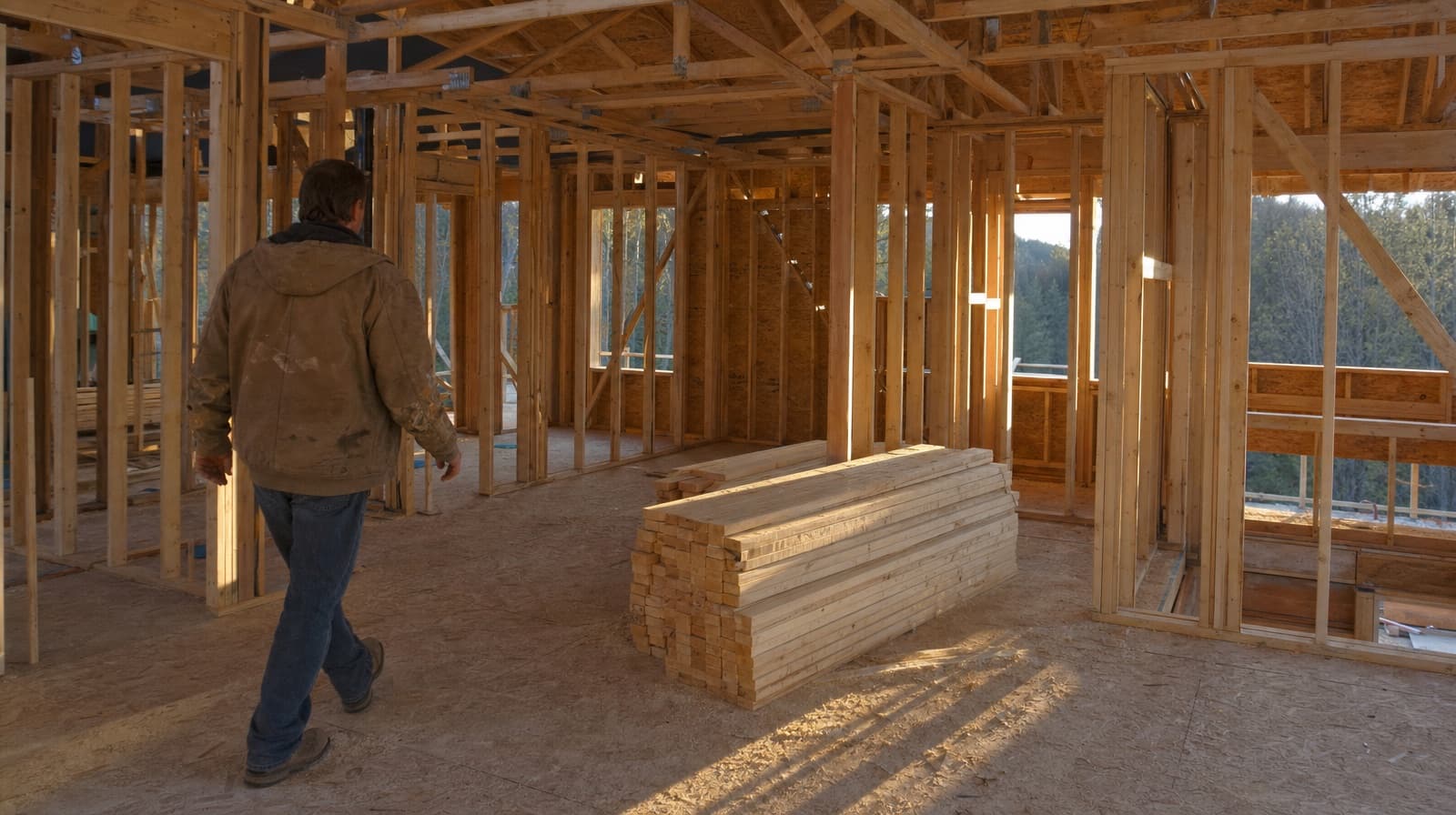
A custom-home builder's cash problem rarely starts with the job. The contract is signed, the homeowner's construction loan has closed, and the budget pencils. The problem is whose calendar the money moves on. Your framing crew, your subs, and your lumber yard expect to be paid on yours — weekly, or on 30-day account terms. The draws that pay for the house move on the construction lender's calendar, one inspection at a time.
We read a lot of builder files, and the shape is consistent: a profitable business whose bank balance swings hardest exactly when the most houses are under roof. Here is where that gap opens on a custom build, the two places it widens, and the one kind of residential project where short revenue-based capital is the wrong answer.
On a custom home, the owner's lender sets your cash calendar
On a custom build — a house built on the owner's land under one general contractor — the money usually comes from the homeowner's construction loan, released in draws against a schedule agreed at closing. Each draw follows the same ritual. You submit a request for the stage just finished. The lender sends an inspector to confirm the percentage complete. Many lenders also want lien waivers from the subs and suppliers paid out of the last draw, plus a title update showing no new liens. Only then does money move. The loop commonly takes several days to a couple of weeks, and it restarts at every stage.
Two details catch builders off guard. First, a draw reimburses work already in place, so every stage is built with your money before it is paid with the lender's. Second, the inspector's percentage is the one that counts. If you call framing done and the inspector calls it 85 percent, you are paid on 85 percent, and the balance rolls to the next visit.
| Build stage | What you are paying for | When the money typically arrives | Where the gap opens |
|---|---|---|---|
| Signing, site work, foundation | Permits, excavation, footings and slab subs, the first lumber order | Owner's deposit if the contract calls for one; first draw after the foundation stage is inspected | Foundation and early framing often run ahead of the first draw |
| Framing and dry-in | Framing crew weekly, the lumber package, windows, roofing | Draw after the lender's inspector confirms the stage, often a week or two after the request | Weekly crew payroll meets a draw that arrives on the inspector's calendar |
| Rough-ins | Plumbing, electrical and HVAC subs billing at rough, insulation | Draw after rough inspections pass | A failed inspection pushes the draw; the subs still expect to be paid |
| Finishes | Drywall, cabinets, counters, flooring, trim, deposits on special-order items | Stage draws, with change orders added only after the owner and lender approve them | Upgrades and allowance overages are built before they are billed |
| Final and close-out | Punch list, final cleaning, grading and landscaping | Final draw after the certificate of occupancy and the lender's last inspection, sometimes with a holdback | The largest check arrives last, often while the next job is already underway |
Change orders are the gap nobody puts on the schedule
The homeowner walks the framed house and wants a wall moved, the tile upgraded, the covered patio extended. Your crew can build it this week. Getting paid for it takes longer. The change order needs the owner's signature, and on a financed build the lender usually has to approve the budget change too. If the change pushes past what the loan can fund, the owner may have to cover the difference out of pocket before the lender releases anything. Selections that run over their allowances follow the same slow path.
Put a hypothetical number on it. Say a build picks up $22,000 in upgrades and allowance overages across the finish stages, built over several weeks, billed on the next draw the lender will approve, and paid a week or two after that. That is $22,000 of materials and labor you carry for a month or more, on a job that is running exactly as the homeowner asked.
The final draw waits on the certificate of occupancy
The last draw is often the largest single check on a custom home and the hardest to collect on time. It typically releases only after the building department issues the certificate of occupancy, the lender's inspector signs off, and the punch list is worked down — and some lenders hold back a slice until the owner's walk-through items are closed. One failed final inspection, a backordered appliance, or a slow utility hookup can push it weeks.
Meanwhile your next job has broken ground. That is why the end of one build and the start of the next is so often the tightest stretch a builder sees: the old job's last check is waiting on an inspector while the new job's foundation and framing are already on your account. A builder with three or four homes at staggered stages lives in that overlap all year.
A spec home is the wrong job for short revenue-based capital
A spec house is built on the builder's own land with the plan to sell the house and lot together. There is no homeowner's lender releasing draws and no buyer paying in stages. You carry the land, the materials, the labor, and every month of holding cost until the sale closes — and nobody can tell you in advance which month that will be.
According to the Census Bureau's Survey of Construction, single-family homes built for sale averaged about six months from start to completion in 2025, while contractor-built homes on the owner's land averaged about ten and a half. The spec timeline looks shorter on paper, but it stops at completion. The clock that matters to a spec builder runs until the closing table, and the market sets it.
That is a poor match for revenue-based working capital, which is built to be repaid out of your ongoing revenue over a short horizon. A spec house produces no revenue until it sells, so short capital puts a payment on a house that cannot make one. The right tools are the ones built for that timeline — a builder's construction line or spec construction financing from a bank, where the house and lot secure a term that runs to the sale. We would rather say that plainly than fund the mismatch.
The same honesty applies to a fixed-price custom contract that was bid too thin. If the job loses money at completion, capital funds the same loss at a larger scale. Capital buys time. It does not buy margin. And if the plan is to cover one house's shortfall with the next house's deposit, the problem is pricing, not timing.
A builder's file reads well when the draws are named
Underwriting starts with deposits — how much comes in, how consistently, how long the business has been running, and how much of that cash flow is already committed to other financing. A builder's deposits arrive as draws, in lumps, with quiet weeks while a request sits with the inspector. Read cold, that pattern can look like volatility. Read with the draw schedule beside it, it is simply how custom homes pay. A lump you explain is context. A lump we have to puzzle over is a question — and questions cost days.
- 1
List every active build and its next draw
Owner, stage, the amount of the next draw, and when you expect the inspector. That one page turns a lumpy statement into a schedule.
- 2
Flag what is built but not yet billed
Change orders waiting on approval, allowance overages riding on the next draw, and final draws waiting on certificates of occupancy. That is the real size of your float.
- 3
Size to the deepest week, not the contract price
The ask is the gap between what goes out before the next draws land and what comes in — not the value of the houses. Right-sized beats bigger: the biggest number a formula produces is how builders get over-extended.
From there it is one dedicated advisor, start to finish, who already knows what a draw inspection and a lien waiver look like. Decisions are made in-house, and once documents are signed the move to funds is measured in days, not weeks. Because builder income lands in lumps, read how any funding agreement handles early payoff before you sign it.
Sources
- [1] Average Length of Time from Start to Completion of New Privately Owned Residential Buildings — U.S. Census Bureau and U.S. Department of Housing and Urban Development, Survey of Construction (2025). Annual averages by purpose of construction: single-family homes built for sale averaged 6.1 months from start to completion in 2025; contractor-built homes averaged 10.5 months.
- [2] Survey of Construction: Definitions — U.S. Census Bureau. Defines contractor-built houses (built on the owner's land under a single general contractor) and houses built for sale (built on the builder's land and sold with the land in one transaction).
Express Capital Funding · Direct lender
See what your revenue supports
We underwrite in-house and fund from our own balance sheet. $250,000+ in yearly revenue, 1+ year in business, and a 580+ credit score is the gate — a decision the same day, funding in as little as 24–48 hours.
4.8★ from 590 reviews · A+ BBB accredited · $250M+ funded
The Residential GCs & Builders library


Frequently asked questions
Can a custom home builder get working capital while waiting on construction loan draws?
That is one of the most natural uses of working capital in residential building. The facility is sized to the gap between weekly sub and supplier bills and the next draws, not to the price of the house, and is repaid as those draws release. Bring your draw schedule — it is what explains your deposits.
Should I use short-term business funding to build a spec house?
Usually not. A spec home produces no revenue until it sells, and revenue-based working capital is built to be repaid out of ongoing revenue over a short horizon. Spec construction belongs with financing whose term runs to the sale, such as a builder's construction line from a bank, where the house and lot secure it.
Why is my final construction draw taking so long?
Because the final draw usually waits on several sign-offs at once: the certificate of occupancy, the lender's final inspection, and often the punch list or the owner's walk-through. Any one of them can add weeks. Plan the start of your next job as if the final draw will arrive late, because it often does.
How do home builders cover change orders before the next draw pays?
The best answer is to collect payment for upgrades and allowance overages from the homeowner when the change order is signed. Where that is not possible, or the lender must approve the budget change first, short-term working capital can carry the cost until the next approved draw — sized to the change orders in progress, not to the whole job.
Do lumpy draw deposits hurt a home builder's funding application?
Not when they are explained. Draw-based deposits are the normal shape of residential building, and a list of active builds with their next draws turns them from apparent volatility into a schedule. Underwriting weighs how consistent deposits are over time, how long the business has run, and what is already committed to other financing.
Keep reading

Published by Express Capital Funding, a direct lender to U.S. small and mid-sized businesses. This article is general information, not financial, legal, or tax advice, and is not an offer or commitment to lend.
← More industries