
Industries
Plumbing & Electrical Contractor Funding
Service calls pay at the door; install jobs pay on terms. How plumbing and electrical contractors fund parts inventory, van repairs, and the net-30 gap.
The short answer
Financing for a plumbing or electrical business usually means revenue-based working capital, not a loan against the truck. Service-call revenue is steady and install lumps are explainable, so these trades underwrite well. The published basics: $250,000 or more in yearly revenue, a year or more in business, and a 580+ credit score, with funding from $10K to $350K — strongest for parts inventory, bridging net-30 and net-60 install work, and van repairs.
Key takeaways
- Service-call deposits give these trades a steadier baseline than most contractors have — name the service-versus-install mix and the file reads on its real shape.
- Parts on the shelf are response time, and response time wins same-day work; supplier cash discounts can offset part of the funding cost.
- A down service van is a revenue outage, and repairing it is a working-capital job — but a vehicle purchase belongs with equipment financing, not this product.
- Bridge net-30 and net-60 install jobs with capital sized to the gap, not to the contract value.
- Fund a return, not a slide: if call volume has been shrinking for months, borrowed money hides the problem instead of fixing it.
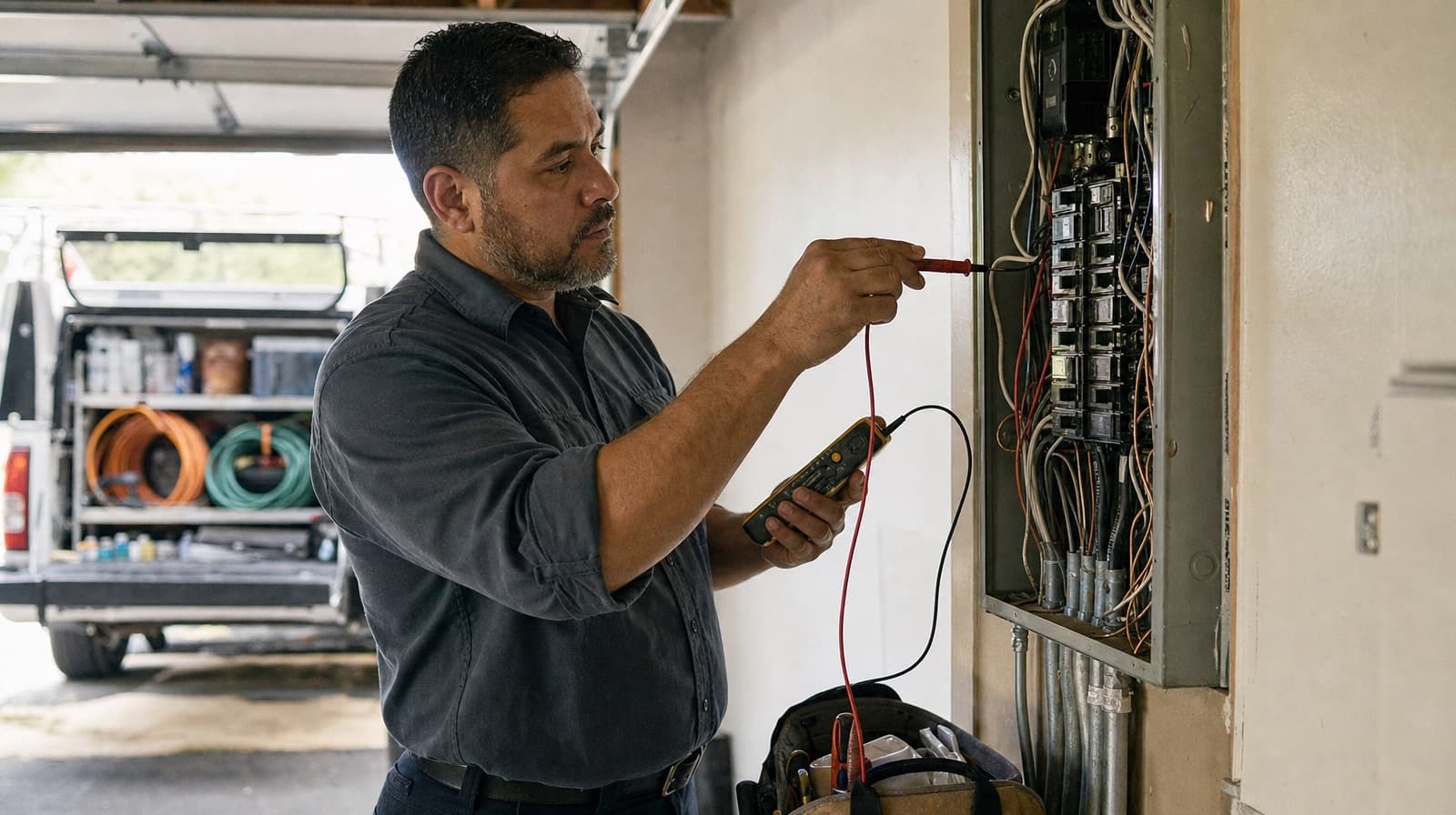
A plumbing or electrical shop is really two businesses sharing one set of trucks. The service side — the stopped-up main, the dead panel, the water heater that quit on a Sunday — bills at the door and pays this week. The install side — the repipe, the panel-upgrade contract, the tenant-improvement bid — pays on net-30 or net-60 terms, weeks after your crew and materials are already spent. Most funding conversations in these trades start because one side of the business is momentarily carrying the other.
We fund service-and-install trades constantly, and the files follow a recognizable shape. Financing for a plumbing or electrical business usually means working capital for exactly that gap — not a loan against a truck or tools. Here is how a lender actually reads that shape, where borrowed money earns its keep in this trade — and the situations where it is the wrong tool, because those matter just as much.
A service-and-install shop is two cash flows wearing one bank account
Underwriting starts with deposits — how much, and how steady. Plumbing and electrical shops have an advantage here that pure construction outfits envy: service work throws off frequent card, check, and ACH deposits all month long, which gives the file a reliable baseline. The install side then drops lumpy contract payments on top of it. Blended on a bank statement, the two can look erratic when the truth is two perfectly clean patterns. A lump you explain is context. A lump we find is a question — and questions cost days.
| Service work | Install and contract work | |
|---|---|---|
| How it pays | At the door — card, check, or ACH the same week | Invoice on completion, then net-30 or net-60 terms |
| What the statement shows | Frequent smaller deposits, all month long | Occasional large deposits, sometimes with quiet weeks before them |
| What an underwriter asks | Is the call volume holding? | Which jobs are open, and when do they pay? |
Parts on the shelf are what same-day service is made of
In the service trades, inventory is not a warehouse play — it is response time. The shop with the right water heater, the 200-amp panel, the wire and fittings already on the truck closes the job today. The shop that has to order it hands the customer a reason to call someone else. That is why parts stock is one of the highest-return uses of working capital in this trade: it converts directly into jobs you would otherwise lose, at your highest-margin moments.
- How fast does your parts stock actually turn — and how many calls last month ended in “we’ll have to order it”?
- What does your supply house offer for paying cash or paying early, instead of riding their terms?
- What is a lost same-day job worth once you count the repeat customer and the referrals behind it?
That second question hides real money. Say your supply house takes 4% off a $20,000 stocking order paid up front — that is $800 of the funding cost paying for itself before you count a single same-day job the stock lets you close. Hypothetical numbers, but the structure is the point: an inventory buy that turns quickly is one of the few uses of capital that starts earning the week it lands.
A van in the repair bay is a revenue outage, not a repair bill
Every service vehicle in your fleet is a revenue stream with a ladder rack. When a transmission gives out or a van fails inspection, the real cost is not the repair invoice — it is every call that van was booked to run while it sits. Say one van handles eight calls a week at a $400 average ticket; that is roughly $3,200 a week of revenue parked in someone else's shop. Getting it back on the road in days instead of weeks is exactly the short, self-repaying need revenue-based funding is built for: sized small, moved fast, and paid back out of the revenue the van goes straight back to producing.
Repair, note — not replacement. Those are different jobs for different products, which brings us to the honest part.
When working capital is the wrong tool for this trade
Buying a new service van or a bucket truck is not a working-capital job. A vehicle is a multi-year asset, and the right structure for it is equipment or vehicle financing, where the asset itself is the collateral and the payback runs on the asset's timeline. Revenue-based working capital runs a shorter cycle by design — putting a five-year purchase on it means paying for the truck out of the next several months of sales, which strains the very cash flow the product exists to protect. If that is your situation, an advisor here will say so and point you toward the right product rather than fit you to the wrong one.
- If call volume has been sliding for several months and the plan is to borrow through it, capital will hide the problem rather than fix it. Fix the phone first; funding amplifies a working business.
- If the money would go toward payments on an existing advance, that is stacking — the fastest way to turn a solvable gap into a structural one. Pay a position down first, then take another look.
Sometimes the honest answer is not yet, not this much, or a different product. Saying so out loud is a large part of why most of our clients come back.
What a plumbing or electrical file needs to show
The published basics are the same for every trade we fund: $250,000 or more a year in revenue, a year or more in business, and funding from $10K to $350K sized to what your deposits support. Decisions are made in-house by a real person, often the same day the statements are reviewed. Funded files see money in as little as 24 to 48 hours.
- 1
Pull three to six months of business bank statements
Deposits and their consistency carry the most weight. For a service trade, the statements are the file.
- 2
Write down the mix
Your service-versus-install share, the handful of customers who pay on terms, and any seasonal months. An explained shape underwrites better than a discovered one.
- 3
Size the ask to the need
The parts order, the van repair, the payroll gap on a net-60 job — fund that number, not the biggest number a lender will offer. Right-sized beats bigger, every time.
From there it is one dedicated advisor, start to finish — not a call center — someone who knows what a supply-house bill and a pay-when-paid clause look like. Terms are shaped by six factors, including monthly revenue, credit, term length, and returning-client status, so the honest way to learn your number is a short conversation, not a rate table on a website.
Express Capital Funding · Direct lender
See what your revenue supports
We underwrite in-house and fund from our own balance sheet. $250,000+ in yearly revenue, 1+ year in business, and a 580+ credit score is the gate — a decision the same day, funding in as little as 24–48 hours.
4.8★ from 590 reviews · A+ BBB accredited · $250M+ funded
The Plumbing & Electrical library


Frequently asked questions
Can I use this funding to buy a service van or truck?
Usually that is the wrong product for the purchase. A vehicle is a multi-year asset best matched with equipment or vehicle financing, where the vehicle itself is the collateral. Revenue-based working capital fits the shorter-cycle needs around your fleet — repairs, parts inventory, payroll, and bridging slow-paying install work. An advisor will tell you plainly which product fits.
How much funding can a plumbing or electrical contractor get?
Funding runs $10K to $350K, sized off your deposits rather than a formula for the trade. Terms are shaped by six factors — credit, monthly revenue, term length, outstanding debt, industry, and returning-client status — so two shops with identical revenue can see different structures. Your advisor walks you through your actual number.
Will lumpy install payments hurt my application?
Not when they are explained. Large occasional deposits from contract work read as structure when you name the jobs and their payment terms, and as volatility only when they are left unexplained. The steady service-call baseline underneath actually strengthens the file compared with most contractor statements.
What documents do I need to apply?
A short application and your last three to six months of business bank statements — complete PDFs downloaded from your bank, sent to your advisor. Decisions are made in-house by a real person, often the same day the statements are reviewed, with funding in as little as 24 to 48 hours after signing.
Keep reading


Published by Express Capital Funding, a direct lender to U.S. small and mid-sized businesses. This article is general information, not financial, legal, or tax advice, and is not an offer or commitment to lend.
← More industries