
Industries
Excavation and Site Work Contractor Funding
How excavation and site work contractors fund fuel, rentals, hauling and payroll before the first pay estimate, and why buying the machine is a different job.
The short answer
Excavation and site work contractors often fund the mobilization gap with short-term working capital: equipment transport and rental, fuel, hauling and crew payroll all land before the first pay estimate is approved, and the facility is repaid as estimates are paid. Weather days and long public payment cycles widen that gap. Buying an excavator or dozer is different, and equipment finance usually fits it better.
Key takeaways
- Site work is first on the job, so its costs land first: machine transport, rentals, fuel, hauling and crew all run before the first pay estimate clears.
- Rain and frozen ground stop earthwork but not the rental clock, so weather days are a cash cost, not just a schedule slip.
- Public and heavy-civil work commonly pays on monthly measured estimates that take weeks to clear, and retainage on scope you finished early can wait for the whole project to close.
- Working capital fits fuel, rentals, repairs, hauling and payroll. Buying a machine usually belongs in equipment finance, secured by the machine itself.
- A disputed change order for rock or bad soil is a claim, not a receivable. Fund approved work, not work you are still arguing about.
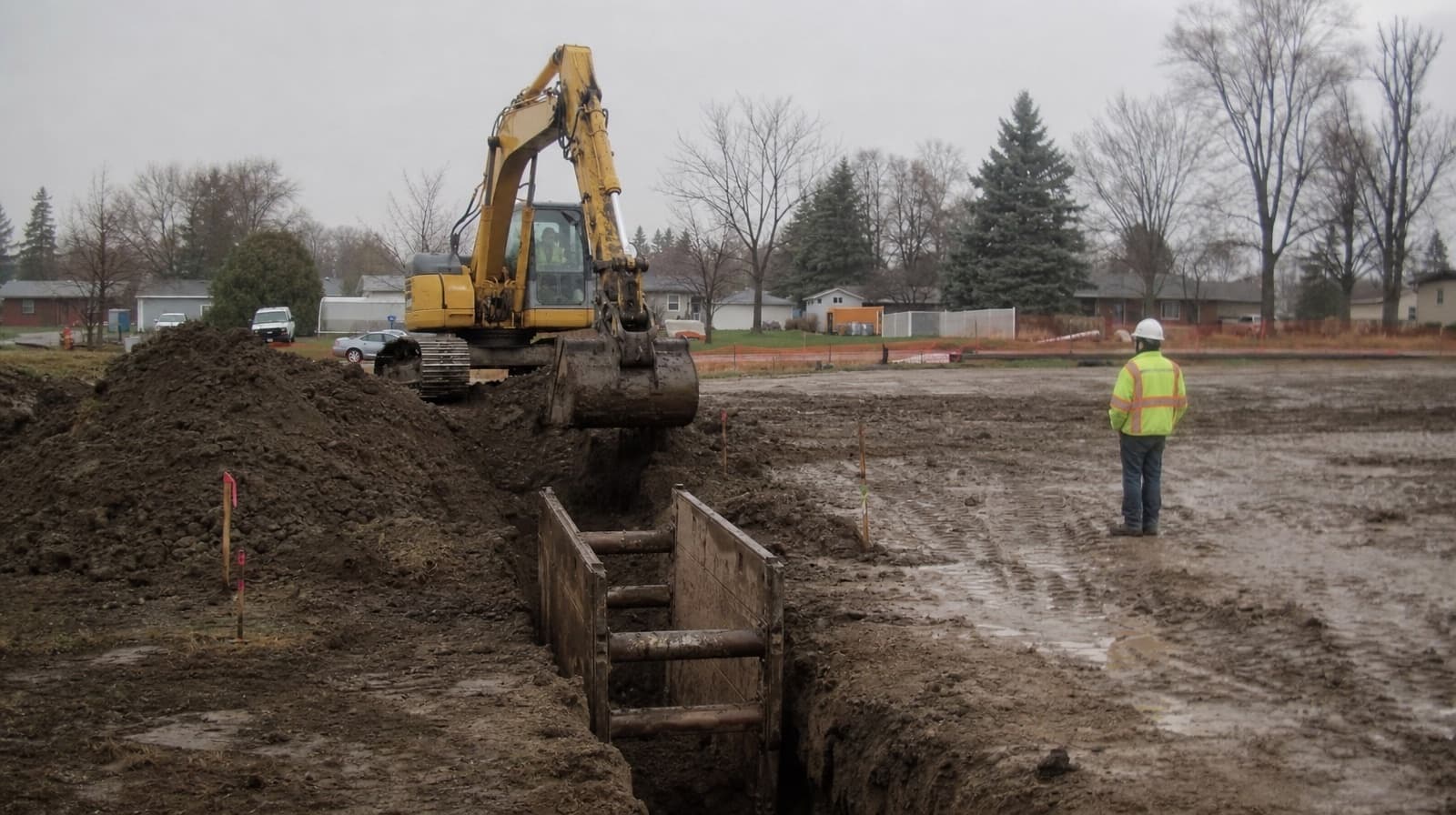
Few trades have to spend as much as site work does before there is anything on the site to look at. Before the first footing is dug, an excavation contractor has moved machines in on a lowboy, started the rental clock on whatever the fleet does not own, set the erosion control, and burned a week of diesel cutting the pad. The pay estimate that covers that work is usually weeks away. Biggest spend first, first payment later: that is the shape of the trade, and it is where most of its funding questions start.
First on site means first to spend
On a typical building or subdivision, site work runs in two visits. The heavy front end comes first: clearing and grubbing, erosion and sediment control, mass grading, cut and fill, building pads, then trenching for storm, sanitary and water lines. Then, often months later, the crew comes back for backfill, final grade and paving prep. Every other trade on the project is waiting on the first visit, which means the site contractor's costs land at the moment the project has paid the least.
Some of those costs are set by rules rather than choices. Federal safety rules require a protective system for excavations unless they are entirely in stable rock, or less than five feet deep where a competent person finds no sign of a potential cave-in, according to OSHA. In practice that means sloping the walls, shoring them, or setting a trench box, so trench protection is often a rental bill that starts the week utility work begins, well ahead of the estimate that pays for it.
| Cost | When it usually lands | What usually funds it |
|---|---|---|
| Lowboy transport to move machines on and off site | Before day one, and again at demobilization | Working capital, or a mobilization line item in the contract |
| Rented excavators, dozers, rollers and loaders | Commonly billed on monthly or four-week cycles, running whether or not the ground is workable | Working capital |
| Diesel | Weekly from the first day, rising with cut volume and haul distance | Working capital |
| Dump trucks hauling fill in or spoils out | Weekly; owner-operator haulers commonly expect quick pay | Working capital |
| Trench boxes, shoring and dewatering pumps | As soon as utility trenching starts | Working capital |
| Crew payroll | Weekly from mobilization | Working capital |
| A major repair on a machine you own | Whenever it breaks, usually mid-job | Working capital |
| Buying an excavator, dozer or truck | At purchase | Equipment finance, secured by the machine |
Weather stops the dirt, not the bills
Earthwork lives and dies on soil moisture. Saturated ground will not compact to spec, a wet week can turn a haul road into a recovery job, and in northern markets frozen ground ends the season outright. The rental clock does not stop for rain. Neither do equipment payments, insurance, or the core crew you intend to keep. On a unit-price job, revenue is measured in yards moved, so a rained-out week is a week of costs with nothing to put on the next estimate.
That shows up plainly in a site contractor's bank statements: thin deposits in the wet months, a surge when the ground dries out and three jobs bill at once. To an underwriter who does not know the trade, that looks like volatility. To one who does, it looks like weather.
Public and heavy-civil work pays on the engineer's calendar
Much of site work is bid by the unit: cubic yards of excavation, linear feet of pipe, tons of stone. Each month the quantities are measured, a pay estimate is prepared, the owner's engineer or inspector reviews it, and only then does it enter the agency's payment cycle. From work in the ground to money in the account commonly runs 30 to 60 days or more, and if you are a subcontractor to a prime, the prime's own cycle sits on top of that. Retainage is often withheld from each estimate as well.
Then there is the closeout problem particular to early trades. The site contractor may finish mass grading and utilities in the first few months, but on many contracts the retainage on that scope is released only when the whole project is accepted, which can be a year or more after the crew left. Some contracts provide for early release of retainage for trades that finish early, or reduce it once the job passes a percentage complete. Ask about it before you sign, not after.
Put hypothetical numbers on the front end. Say a site contractor wins a $420,000 grading and utilities package. Moving three machines on site, a month of rental on the two it does not own, trench boxes for the storm line, six weeks of diesel and haul trucks, and payroll until the first estimate pays could total around $110,000 before the first deposit. The deepest point of that gap arrives just before the first check, so the right ask is that number, less the cash already in the business, plus a cushion for a slow estimate. It is not the $420,000 contract.
Running the machine and buying the machine are different jobs
When a site contractor says they need money for equipment, they usually mean one of two very different things. Running costs (fuel, rentals, repairs, hauling, the operator's payroll) come and go with the work, and short-term revenue-based working capital is built for exactly that kind of need. Buying the machine is an asset purchase. An excavator works for years and holds resale value, and equipment finance, where the lender takes the machine as collateral and sets a term matched to its working life, is usually the better structure. Paying for a seven-year machine out of a short-horizon facility squeezes years of asset payments into a few months of your cash flow.
A repair is a different story. A blown hydraulic pump or a failed final drive in the middle of a job is urgent, it does not create a new asset to secure, and the job you are on pays for it. That is a working-capital job. So is the cost of putting a newly financed machine to work: the transport, the operator, the fuel and the weeks before its first estimate pays. And if you have rented the same dozer for eleven months straight, the honest question is whether to buy it with equipment finance, not how to fund the rental forever.
When funding is the wrong tool for a site contractor
- A disputed change order. Rock you did not bid, or unsuitable soil you had to haul off, is a real cost. But until the change order is approved, it is a claim, not a receivable. Fund approved work. Do not fund an argument.
- An underbid unit price. If the price per yard does not cover fuel, hauling and machine time, more volume only loses more money. Capital buys time. It does not buy margin.
- A machine purchase. As above, equipment finance sized to the asset's life usually fits better and costs less over the machine's life.
- Covering last month's payments with a new advance. If the gap never closes from job to job, the problem is pricing or payment terms, and stacking a second position on the first turns a timing problem into a spiral.
What fits cleanly is the mobilization of a signed job, the rentals and fuel between estimates, the repair that keeps a machine earning, and payroll through an estimate that is approved but not yet paid. Size it to the gap, time it to the payment schedule, and line it up when you sign the contract rather than the week the first estimate runs late. A direct lender decides in-house, so the move from signed documents to funds is measured in days, not weeks, and one advisor reads the whole picture, rain-outs included.
Sources
- [1] 1926.652: Requirements for protective systems — Occupational Safety and Health Administration. Requires protection from cave-ins in excavations unless they are entirely in stable rock, or less than five feet deep where a competent person's examination of the ground shows no indication of a potential cave-in.
- [2] Trenching and Excavation: Overview — Occupational Safety and Health Administration. Describes the protective methods: sloping or benching trench walls, shoring them with supports, or shielding them with trench boxes.
Express Capital Funding · Direct lender
See what your revenue supports
We underwrite in-house and fund from our own balance sheet. $250,000+ in yearly revenue, 1+ year in business, and a 580+ credit score is the gate — a decision the same day, funding in as little as 24–48 hours.
4.8★ from 590 reviews · A+ BBB accredited · $250M+ funded
The Excavation & Site Work library


Frequently asked questions
Can an excavation contractor get working capital while waiting on a public agency's pay estimate?
That gap, with work in the ground and the estimate still in review, is exactly what short-term working capital is designed to bridge. Bring the contract's payment terms and your recent estimate history to the conversation so the payback can be timed to when the agency actually pays, not when the contract says it should.
Should I use working capital or equipment financing to buy an excavator?
Equipment financing, in most cases. The machine secures the facility and the term can match its working life, which usually makes it the cheaper structure over time. Working capital fits the costs of running the machine: transport, fuel, the operator, repairs, and the weeks before the job it works on starts paying.
Will a rainy season hurt a site contractor's funding application?
A rainy season reads very differently when it is explained. Underwriting reads deposit level, consistency over time, time in business and existing obligations, and a weather-driven dip with a clear story reads as the shape of the trade rather than as instability. Note which months lost days to weather and which jobs were mobilizing, and the file is read on its real pattern.
Can I get funding to cover a change order the owner has not approved yet?
That is the one to be careful with. Until a change order for rock or unsuitable soil is approved, it is a claim, and borrowing against money that may be negotiated down or never paid deepens the gap instead of bridging it. Approved change orders on signed work are a different conversation.
How much working capital does a site contractor need to mobilize a job?
Size it to the gap, not the contract. Add up transport, rentals, fuel, hauling, trench protection and payroll until the first estimate realistically pays, subtract the cash you can commit, and add a cushion for a slow approval. That number, not the contract value, is the ask.
Keep reading

Published by Express Capital Funding, a direct lender to U.S. small and mid-sized businesses. This article is general information, not financial, legal, or tax advice, and is not an offer or commitment to lend.
← More industries