
Insights
Landscaping Spring Startup Costs: The Eight Dry Weeks
What the spring ramp actually costs a landscaping company — rehiring, fleet prep, and materials paid weeks before the first invoices land — and how to fund it.
The short answer
A landscaping spring ramp runs six to eight weeks of spending before the season's first invoices pay. Crews return to payroll in March, fleet recommissioning and insurance come due, and materials are cheapest bought up front — while April's maintenance invoices don't clear until net-30 terms run out in late May. Revenue-based working capital sized to that gap is repaid out of the peak season it launches.
Key takeaways
- The spring ramp is six to eight weeks of payroll, fleet, and materials spending before the season's first invoices clear.
- Rehiring is a financing decision: your market recalls from one labor pool in a three-week window, and a confirmed start date is what wins your crew back.
- Early-order materials pricing rewards cash in March; spring-rush pricing punishes waiting until May.
- Apply on late-winter statements with the seasonal pattern declared, not at the April trough.
- Finance a ramp that serves signed contracts — staffing up to chase an unsold season is speculation, not a bridge.
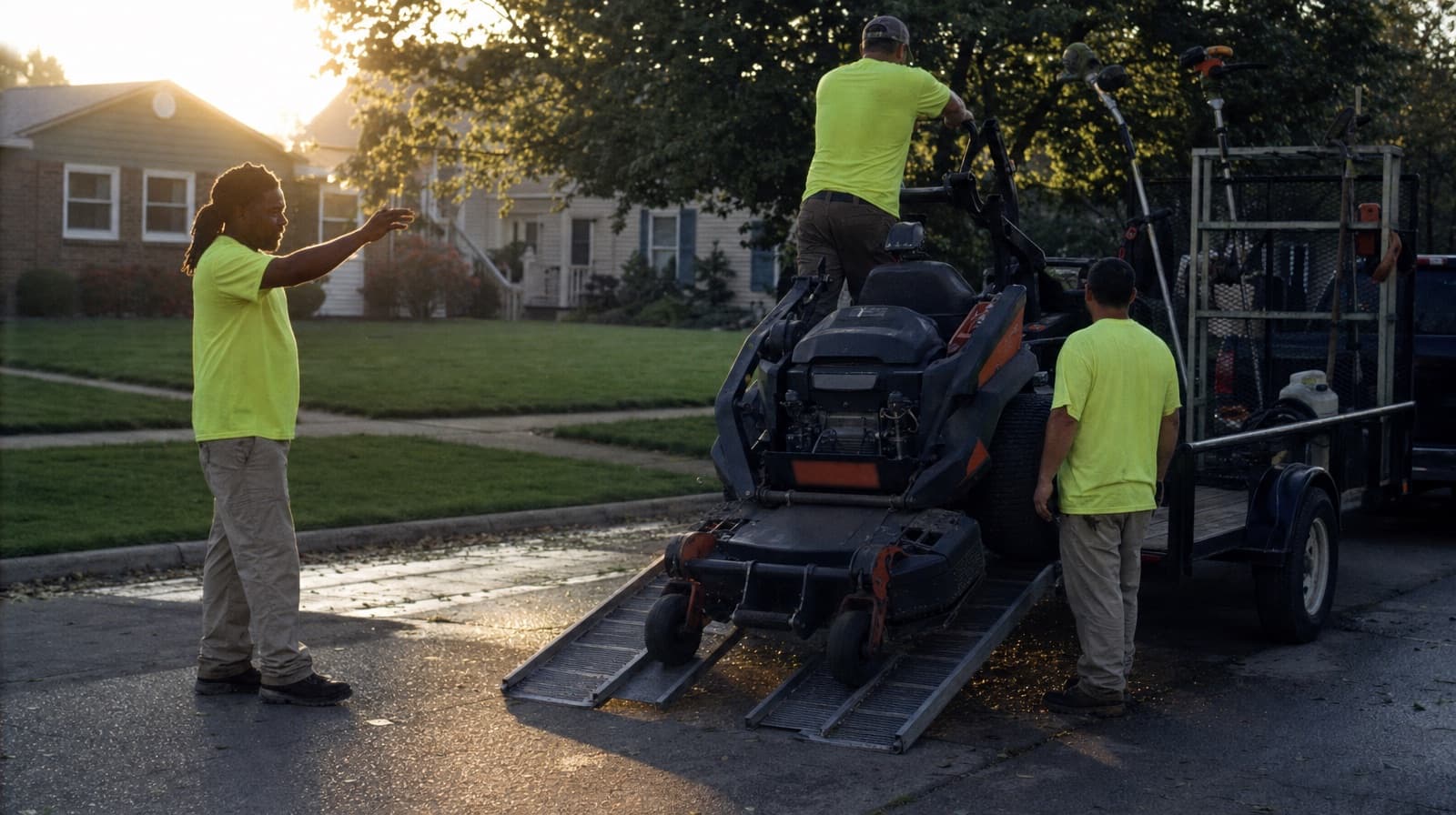
The first mowing invoice of the season is not the start of a landscaping company's year. The year starts six to eight weeks earlier — the day the first returning crew member goes back on payroll, the mowers go in for service, and the fertilizer pre-buy comes due. Everything in that stretch is money going out. Nothing in it is money coming in.
Our landscaping industry guide covers the whole counter-seasonal year — both ramps, both shoulder gaps. This is the close-up on the spring side, because it is the more expensive of the two and the one that decides what kind of season you have. Here is where the money actually goes, in the order it leaves.
The ramp is a payables sprint that ends in a receivables crawl
Spring spending is not one bill. It is a stack of them, arriving in a fixed order that does not care when your customers pay. The sequence runs roughly the same in every northern-tier operation we see:
| When | What comes due | What is billing |
|---|---|---|
| Late February | Return offers to key crew, insurance renewals and deposits, fertilizer and mulch pre-buy deadlines | Snow work, if you have it — otherwise nothing |
| March | Crews back on payroll, mower and truck recommissioning, registrations, fuel accounts reopened | Nothing yet |
| April | Full payroll plus the first install materials | First maintenance invoices go out — most at month's end |
| May | Full payroll and materials at peak burn | Net-30 clocks running; the first commercial checks land late in the month |
Notice what the right-hand column does: it stays close to empty for half the table. That is not mismanagement — it is the structure of the trade. Maintenance contracts bill in arrears, commercial accounts and HOAs pay on net-30 to net-60 terms, and residential installs collect a deposit at best. The ramp is a payables sprint, and the money that repays it arrives at a receivables crawl.
Rehiring is won in February and paid for in March
The largest line in the stack is the crew, and it carries a deadline the other lines do not. Every landscaping company in your market recalls from the same labor pool in the same three-week window, and the workers in it — reasonably — sign with whoever offers a confirmed start date and a first paycheck they believe in. A vague we'll-call-you-in-April loses your best people to the competitor who put a date in writing.
That is why the rehire decision is really a financing decision. Confirming a mid-March start means committing to carry three to six weeks of full payroll before the season's first invoice goes out, let alone pays. Owners who cannot make that commitment wait — and waiting is how a five-person crew becomes three experienced hands plus two people learning the trade on your customers' properties, in exactly the window when new accounts are deciding what to think of you.
Materials cost less in March than they will in May
The second pattern of the ramp is that materials are cheapest exactly when your cash is thinnest. Fertilizer pre-pay programs, early-order mulch pricing, and nursery pre-season commitments all reward the buyer who can write a check before the season starts — in price and in priority. When the spring rush hits, suppliers allocate to the accounts that committed early. Everyone else pays list and waits for delivery behind them.
Recent seasons have made the timing cut harder. Input costs — materials, freight, fuel — have kept climbing, and the quote you got in late winter is not the number you should expect in June. The cost of waiting sits on the materials, never on the funding decision itself: a pre-buy made with funded capital at a known cost frequently beats the identical purchase made at spring-rush pricing with cash you finally have.
Landscaping spring startup costs, in dollars
Put hypothetical numbers on a modest two-crew operation and the shape becomes obvious. Say payroll runs $24,000 a month once crews return on March 15. Fleet recommissioning — mower service, truck repairs, registrations — comes to $9,000. Insurance renewals want $6,000 down. The fertilizer and mulch pre-buy is $14,000. By the time the first meaningful commercial checks clear in late May, roughly $89,000 has gone out the door against almost nothing coming in.
None of that is a loss. Every dollar is attached to revenue that is contracted and coming — the maintenance book bills all season, the installs are scheduled, the receivables will land. That is precisely the profile working capital exists for: a short facility drawn against the ramp and repaid out of the peak months it makes possible. The gap is a timing problem, and a timing problem is the clearest shape a working-capital request can take.
It is the same mechanic as any payroll-before-receivable bridge, run on a calendar instead of a single invoice — the season's whole cost structure fronting the season's whole revenue.
Apply on your strongest statements, not your thinnest ones
Here is the part of the file most owners get backwards. The natural instinct is to apply in mid-April, when the pressure peaks. But an application is read off recent bank statements, and mid-April statements show a landscaping business at its least representative moment — full burn, no deposits. The stronger file is the one submitted in late winter, while the trailing months still show fall cleanups and any snow revenue, with the seasonal pattern declared plainly.
A quiet winter with the reason spelled out is a different file from the same winter left unexplained — declaring the seasonality up front frames the trailing months instead of leaving them to speak for themselves. But an explained dip is still a question answered late. The application submitted before the dip never has to answer it at all. Urgency has never made anyone more fundable; timing has.
When the ramp should not be financed
One honest boundary. Working capital funds the sprint to revenue that is contracted: a signed maintenance book, scheduled installs, renewed commercial accounts. If the book has not renewed yet and the plan is to staff up in hope of selling the season once the trucks are rolling, that is not a bridge — it is borrowing to speculate on sales, with payroll as the stake. Sign the contracts first, then finance the ramp that serves them.
And if the need is really a new mower fleet rather than the season around it, equipment financing built for the asset is usually the better tool — our industry guide walks through that split. Working capital fits the costs that put the machine to work, not the machine itself.
The qualification gate is the same one the rest of the trade clears: $250,000 or more in yearly revenue, a year or more in business, funding from $10K to $350K. Decisions happen in-house, often the same day the statements are read, with funding in as little as 24 to 48 hours — days, not weeks. The three-week rehire window is pressure the labor market puts on the ramp, not a reason to rush the funding decision; it is a reason to have the paperwork done before the window opens. Tell your advisor the ramp's actual numbers: the crew date, the pre-buy deadlines, when the first checks land. That story is the file.
Express Capital Funding · Direct lender
See what your revenue supports
We underwrite in-house and fund from our own balance sheet. $250,000+ in yearly revenue, 1+ year in business, and a 580+ credit score is the gate — a decision the same day, funding in as little as 24–48 hours.
4.8★ from 590 reviews · A+ BBB accredited · $250M+ funded
Frequently asked questions
How much does it cost a landscaping company to ramp up for spring?
It depends entirely on crew size and book, but the stack is consistent: several weeks of payroll before invoices pay, fleet recommissioning, insurance renewals, and the materials pre-buy. A modest two-crew operation can hypothetically see $75,000–$90,000 go out before the first commercial checks clear in late May.
When should a landscaping business apply for spring working capital?
Late winter — before the ramp, not during it. Applications are read off recent bank statements, and late-winter statements still show fall cleanups and any snow revenue. Applying at the April trough means applying at your least representative moment, with the payroll clock already running.
Can I qualify if my winter deposits were thin?
Thin winter deposits are common in this trade, and what matters is whether the file supplies the seasonal context or leaves an underwriter guessing. State your peak months, your trough months, and the reason. Better still, apply on late-winter statements — before the trough is the most recent thing on the page — so the question barely comes up.
Keep reading


Published by Express Capital Funding, a direct lender to U.S. small and mid-sized businesses. This article is general information, not financial, legal, or tax advice, and is not an offer or commitment to lend.
← More insights